
AI & What's Next in Dentistry
Dr. Tim Quirt and Dr. Seth Gibree join host Dr. Bill Bloink to discuss how AI can assist doctors in evaluating diagnostic findings and supports clinical decision making. They emphasize that while AI is potentially the biggest advancement dentistry has ever seen, it's a tool to support the doctor, not replace them, because dentistry will always be a people business.
In this episode:

Dr. Bill Bloink
Host Heartland Dental
Dr. Bill Bloink is a Founding Partner of Heartland Dental and Dr. Rick Workman's first business partner. A 1988 graduate of Southern Illinois University School of Dental Medicine, he opened the first Heartland-supported practice in Springfield, Illinois in 1991 — now the support network's second most productive. A national and international speaker on leadership and communication, he has educated tens of thousands of dental professionals.
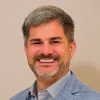
Dr. Timothy Quirt
Guest Heartland Dental
Dr. Timothy Quirt, DDS, MBA serves as Senior Vice President of Clinical Operations at Heartland Dental. After owning 12 dental practices, a dental lab, and a dental assisting school, he joined Heartland in 2012. Rising through clinical and operational leadership roles, he now leads doctor and hygiene mentor networks nationwide. He holds degrees from the University of Wisconsin-Madison, Marquette University, and the Jack Welch Management Institute.
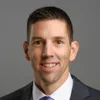
Dr. Seth Gibree
Guest Heartland Dental
Dr. Seth Gibree, DMD, FAGD serves as Senior Director of Clinical AI and Innovation at Heartland Dental. A published author and key opinion leader with 20+ years of experience, he focuses on supporting clinical excellence, AI, and innovation. He established the first Heartland-supported offices in Georgia in 2010, serves on Dentaltown Magazine's editorial advisory board, and leads the non-profit Dental AI Council.
Key Takeaways:
- Dentists are using AI to enhance diagnostics and help catch disease earlier.
- Dentists are the frontline for overall health
- Technology is here to help doctors, not replace them
Transcript
If we believe the best dentistry is the least dentistry and the least dentistry being dentistry earlier on in the lifecycle of damage, then we owe it to our patients to analyze any information that we can get in the diagnostic appointment to say, how can we help you? How can we help you be healthy? How can we help you be healthy earlier?
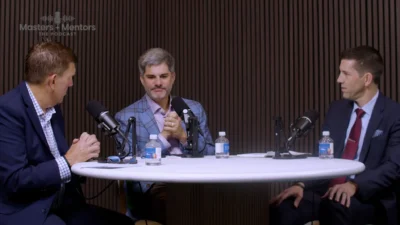
Welcome to Masters and Mentors, the podcast where we talk with leaders shaping the future of dentistry. Today we're exploring the innovations, transferring diagnostics, workflows and patient experience, and how Heartland Dental supported doctors stay ahead of that curve. I'm Dr. Bill Bloink and I'm joined today with Dr. Tim Quirt, Heartland Dental, Director of Clinical Operations. And Dr. Seth Gibree, Senior Director of Clinical Advocacy. Welcome guys. Really, uh, really, really happy to have you, especially on the inaugural
Leaders of Dentistry. Right? So that's a little bit of a, just wanna make sure that we're
Disclaimer. Yeah.
A little disclaimer here this morning.
Really really happy to have you guys this morning. Let's just dive right into it, shall we? You know, Dr. Quirt, uh, you, you're so involved. Both of you're so involved in the technology they're adopting here at Heartland. Can you share with everyone where you see dentistry headed with AI and what has excited you the most in the last five years about technology?
That's a very loaded question, isn't it, Seth? So, first off, Seth and I have known each other for what, 20 years? Some more. And we've been kind of chasing all different type of industry trends, let's say. And the biggest one, I think in the last eight years, 'cause we've spent, it's been about eight years now, was on AI, and still is. I think we were in AI before people thought it was cool. Uh, and boy, I gotta tell you, there is so much going on right now in just in that realm of things that and I don't, I don't want to like over exaggerate this, but I think it is the greatest change to dentistry that we've ever seen. And, you know, as we know, 'cause Dr. Workman will say the same thing, high speed hand pieces, digital x-rays, PVS, all these different advancements over the years. This is the literal largest one.
Yeah. That's great. So finish this, finish this sentence for me. The next big leap in dentistry will come from?
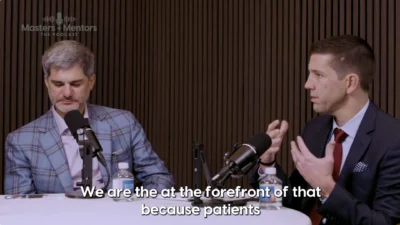
I think, like Tim said, it's the AI realm. Now, if you think about AI, it's software and we've had software for years. It's just the ability of the software to do different things that has just exponentially grown. And I think within AI, where the next big leap is, related to the medical dental integration. So before, like we are at the forefront of that because patients come to see us on a regular basis. A lot of times they don't see their physician on a regular basis. So they're seeing them when they have an emergency or they just feel bad. And so they're not getting a comprehensive exam. With them seeing us on a regular cadence it opens the door for us to be really intervention specialist, so to speak, from a medical side. So I think we'll see a lot of things where in the dentistry realm, we will catch things like diabetes earlier, we'll catch heart disease earlier, we'll catch stroke, Alzheimer's, all those signs and symptoms through salivary testing, other diagnostic tests that are being developed. That before you couldn't manage the data and the science behind that. And nowadays with AI and the things that it's doing, you can actually bring that information together to help people be healthier earlier and live longer.
Let me ask a question though, because it, I think we would all admit we're all dentists. There's a huge disconnect between, the mouth is connected to the body. Am I right on that?
I think It is.
That is the part. There's still something there. You know, I don't know how many more studies we need to show that periodontal disease, for example, is, you know, causes all these other issues in the body with inflammation and cancer and all. How many more do we need for people to actually believe that it's connected to the body?
I think it was a Seinfeld episode that really did us under. "They're just dentists" and Kramer was like, "Wait, they have their own schools?" I think that just threw us for a loop.
That probably was the downfall right there. But until that I, again, I think we're starting to see it more now. Oh, it is part of it, it does cause other issues. And that to your point, I think that when it does start to finally connect a little bit more, but gosh, it's, it's been a struggle.
I mean, there was another study that came out this week that was talking about people that had endo done. Their blood was better. Like, so there's so many, like you said, it just, it's continuing to come out that with a healthy mouth, if you do some flossing, if you take care of your teeth, a healthy mouth leads to a better, longer overall health outcome.
You've talked a lot about the, the great things that are, are coming our way. Is there anything that worries you about the technology that, 'cause there's a lot of discussions about the, the potential downfalls of ai. Is there anything that worries you about the technology?
Yeah, that's a great question. I, I'll say this, I know on the diagnostics, so there, when we talk about AI, there's probably, I don't know, 30 buckets, 30 different ways that you can use it in an office. It's not just diagnostics, but let's just talk on diagnostics right now. It is difficult to talk to a doctor and say, Hey, listen, do you miss something? Do we miss, are we human basically?
In diagnostics?
In diagnostics. And I think most of us will go, yeah, there's, I'm sure there's something there. And we did a study about eight years ago now, and it showed we were all expecting, so we'll go down this road a little bit. We were all expecting us to have missed, let's say, on an x-ray a little bit, right? A couple percentage points. And when we did the study, what we found out was, no, no, no. It's like 20 or 30% of lesions are missed on X-rays. And so we said to ourselves, that can't be right. So we did it again. Same result. Then we said, that can't be right. And then we allowed a lot of these vendors that are out there now to do their own studies. Cause they all had to do 'em for the FDA, correct? To get them credentialed or certified. They have to give the FDA, the similar studies, but on their own third party. They were getting the same result. So now let's step back for a second. If I'm sitting with a doctor and I go, Hey, listen, I, it's hard for me to say to a doctor, I think we're probably missing 20 to 30% of lesions. That can't be right. That shocks me. It shocks me and it makes me feel bad. Right? Let's talk about the psychology of it, right? Wait, I'm missing things at that level. And this is not just us. Again, you look at radiology and medicine. There are similar stats on percentages. We wear so many hats in dentistry, as you know, Bill. I mean, it's like HR. And that's what I love about how we do things at Heartland is that we have people and teams that wake up every morning and that's what they're focused on. So you don't have to worry about all these different segments. Now we're not, we're radiologists, we're surgeons, diagnosticians, we're, you know, there's like a whole list of things that we are, and we have to be. Now can AI help us in this realm? It absolutely can. But going back to, yeah, we're missing things. So now when I talk to you about it and I go, Hey, all right, use it because I think we might be missing things just to give you a heads up. Is this something? And then Dr. Bloink is the one that looks at it and says, is it something or not? That's what I like. At some point in time, we're gonna get a white paper or a study or dental schools are gonna say, no, no, no, you gotta use it. And then there's a liability thing. It's not there right now. That's the question I get right away. Right. I don't want to use it because, am I liable when it's No, you have final say. So again, I, I'll hand it off to Seth 'cause I'm sure he's got a couple points on this too. Well, it's a big topic.
It is. And there's a lot of ways this could go. And I think one of the great things that we get to do is I get to wake up every day and try to figure out how to make dentistry better for clinicians and for patients. And part of that, eight plus years ago, we were in rooms because of Heartland's influence to offer opinions on this type of technology. A lot of the companies in the beginning wanted this to be a definitive diagnostic tool. Like this is the final diagnosis. And we were very adamant that this was an aid to the doctor because ultimately the doctors are the ones that make the decisions for their patients and the communities that they serve. And so we were very passionate. Yes, I would say, that it was important that this was an aid so that it always went back to the doctor to make the final decision. But I think the challenge to what he's saying is, if we believe the best dentistry is the least dentistry and the least dentistry being dentistry earlier on in the lifecycle of damage, then we owe it to our patients to analyze any data that we can get or any information that we can in the diagnostic appointment to say, how can we help you? How can we help you be healthy? How can we help you be healthy earlier? How can we use things like curodont now and, and say we can help heal a tooth before we ever have to drill on it and start that cycle of drill, fill, bigger drill, bigger fill, crown, root canal, eventual extraction, implant, that whole life cycle of damage. We can help stop earlier. And if we believe that the best dentistry is the least dentistry, catching it earlier in that cycle is better. Now the biggest I think, challenge for us is the change management component. And that goes back to what Tim was saying. It's a belief window. If a doctor says, I don't necessarily believe I need it. Even, I remember the first doctor that we had a doctor that said, okay, you can use a million of my patient x-rays. And we went through like de-identification and all that to make sure everything was, um, no PHI and all that was on it. And we gave him the stats of what was going on and his x-rays versus what basically an FDA approved model showed. He didn't like it, because he's like, there's no way I have missed that much stuff that much. Right. Back to the change management thing, even if he didn't need it though, is it fair to his patients not to look at it and not to say, man, I, I see this earlier now, or it put my eyes to something that I would've missed otherwise. And we all get tired and like Tim said, we all mess up. None of us are perfect. And so I think it's super important that we owe it to our patients to look at this stuff. But people are people and people don't like change. And we hear it all the time from other dental, I hear it all the time from other dental groups, from other dental offices. How do you get your supported doctors and teams to buy in? To understand? And I think we do that on the front end as we look at technology and we look at innovation, we look at how a doctor thinks about this, how this influences the team, what's in it for them, how it hits every single person in the office, in the pilot stage before we go to rollout. Because we have to understand how to make this easy. Because if it does, if it doesn't fit in the systems of the flow of what they do day in and day out, it's not gonna work. They're not gonna adopt it. I'll give you a short story. A friend of mine worked for a diabetes innovation company. They had a great diabetes one treatment where it was super easy, it was really data-driven. Great results, but the doctors that he tried to work with said, it won't work in our office because this is how we do it. And unless my team can do it, then we're not doing it. And he never could overcome that. And that was something that always stuck with me because it's like, you have this thing that will help somebody, but you really have to think through change management. I think that's one of the great things that Heartland really does, is we think deeply about change management so much Tim was talking about all these different support levers we have. I get to work on innovation and AI all, all the time, but we have people that work on change management from a full-time and help say, okay, help an office to say this is an ideal way to use this. Obviously everybody's office is a little bit of a different ecosystem. And so I think that's what's unique about what we get to do is there's so many similarities and systems that work that are consistent, but every office is based on the community that they're in and they're unique. And I think that's what really is special about kind of our collaboration of people, if that makes sense.
It's, that's terrific. You know, you, you talked, you talked a little bit about under utilization of technology, I also a potential danger in the over utilization of technology. I mean, there's such a, uh, a dynamic between a practice, a doctor and his or her team and a patient Yes. To where if we over utilize the technology, do you, do you see a danger of a doctor for example, just saying, well, this is just what the technology says.
Correct. Yeah. Here's what it is and you gotta put a crown on it. No, I, I think I want Dr. Bloink to make that decision, not the software making decision. Now, will that happen in the future? I don't know. I mean, I do think at some point they're gonna say it's more accurate than we are. Well then what happens? You know, but going back to, you can over rely on it. You can under rely on it. But what we found is, and we did a big study on this, the bell curve of results of this, every single doctor that utilized it missed less and got better case acceptance. And that's the key.
I thing to piggyback on that really quick too. If you believe as a doctor that what you're diagnosing for Tim, so if you're patient and you say, Tim, I believe this is what you need, and you have a tool that 20% more of the time he's gonna say, yes, I'll move forward with treatment. And you believe that's the best thing for him in that moment, I think you owe it to him to say, Hey, here's what this shows you too, just because a picture's worth a thousand words and, and that say but you always say something that dentistry is not the tooth business. It is the people business. It's about the person that's in the chair. And so over reliance on technology is a concern for me. But one thing through the lens that I look at that is that lens specifically of us being in the people business, because we can use technology for the manual things that are being done within the office flow now to be able to spend more time on that human to human connection, that doctor patient relationship to that hygiene patient relationship.
I love that.
And so I think that's where I get super excited about things because we can actually make dentistry even more relational. So as we think about things that take a long time in an office, notes take a long time for doctors and for hygiene to work on notes in the course of their day. And so if there's something that helps them automate that process or make that process easier, and there are technologies that we're looking at that do that, then that gives you more time with your patient. And I think that's, those are the things that I get really excited about is how can we save that manual time perio probing. I mean, how many of our hygienists would love some sort of voice perio probing? I believe it will be mainstream by the end of the year. A lot of the things that we're working on that influence dentistry as a whole, I think will come to fruition and are super exciting too.
And you know, that excites me for young doctors because young doctors are so focused on the technical aspects of their work that sometimes they miss the relational part. And so, how do you see the AI helping newer doctors expand their, their horizons in all aspects of their practice? And at the end of the day, as you guys said, we are in the people business. Business. Yeah, we are. And anything that we can do to help people is good.
A hundred percent. And I'm in a double-edged sword this for us, ready? Yeah. It's a big term, right? They did a study, I remember it was 30 years ago, Bill, uh, with intraoral cameras and a hand mirror. And they found the results were the exact same because it's what you talk about and how you communicate to the patient, that's the most important thing. So meaning take a couple pictures and show it to the patient or give them a hand mirror and really talk to them about, do you see this right here? It's you again, if we're making a message out there, it's yeah, use the technology wisely. Don't overuse it, but also understand it's a people business.
And so I think it goes back to what Tim was saying earlier is like, what's your mindset? Are you a glass half full? What's your perspective to this situation? Or do you see your hundred plus problems a day as problems or opportunities to solve?
That's a win for everyone, right? For sure. Big time. Got 30 seconds. I wanna ask you both this question, if you could bust one myth about AI and what's coming with AI in 30 seconds or less, what's a myth that you would bust about AI?
Well, that's a tough question. I think that it's going to fix everything on its own. And I got two, and it will replace everybody's job.
Oh that was the one I was gonna take.
I took a second one. The fear side of it's going to take my job is unfortunate, because I don't believe that's true. I think we have to, we also can't bury our heads in the sand and say, I'm going to live in a world without that, when the world is going to have that. If that makes sense. So you have to be conscientious of how to exist and how to live in a world that includes software and technology that does things to help us day in and day out. So, it's not gonna take, we're in the people business.
And I'll just, I, sorry. Hey, you can't, you can't just throw out six of 'em and then hey, try to beat that. No. I do think a lot of people think it's gonna take their job. And all I'll say in that is, listen, the train has left the station. Feedback is the most important thing right now. Meaning if what's working, what's not working, what you want it to do, please voice it. And I know for a fact people will get it, you know, incorporated in whatever they're working on. That's the key part here. Go ride it. Ride the bus, and give feedback. That's what I want everybody to do because
We're gonna continue to learn and work on Doctor's Behalfs. It's what we do every day.
Yes. At the end of the day. Yeah. It is for doctors, their teams. Yeah. And the patients. Yes. Well, fellas, I wanna thank you both for, for being with us today. It's been a real pleasure. In this inaugural session of the Masters and Mentors Podcast. If you are interested in learning more about our podcast, follow us at heartland.com/podcast so you never miss another episode.


Episode Highlights
Grow With Heartland Dental Supported Practices
Wherever you are on your dentistry journey, Heartland Dental and supported practices provide the support, tools, and opportunities to grow your career or your practice with confidence.

Sell your Practice
Explore how Heartland Dental supported practices help relieve the non-clinical burdens so you can grow your practice, advance your tools and technology, and improve patient outcomes.
Sell Your Practice
Careers in a Supported Practice
If you want to explore open positions at Heartland Dental supported practices across the country, this is the place.
Explore Opportunities